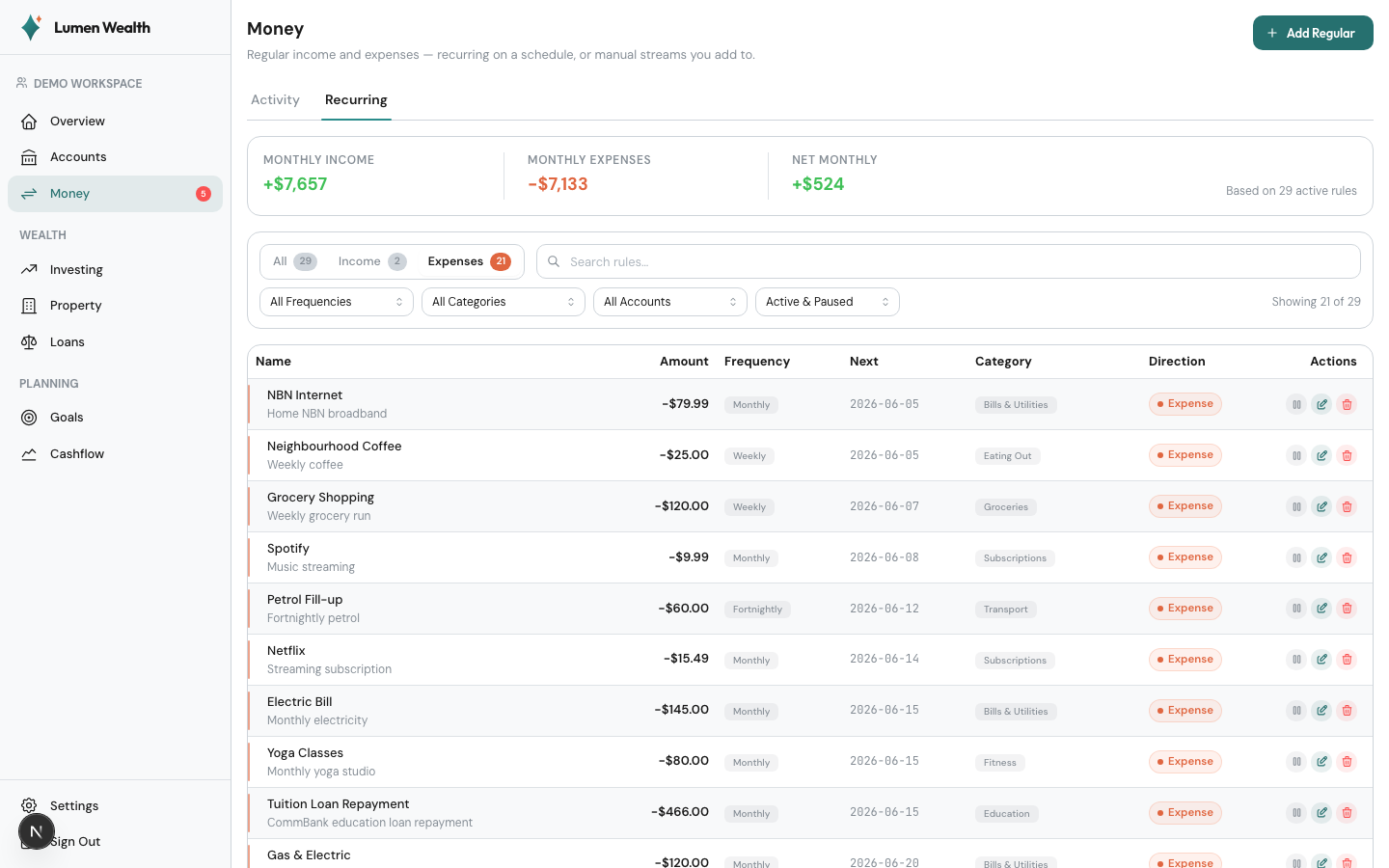
Planned Money
Planned Money covers the cashflows that shape your financial baseline before discretionary spending enters the picture.
Salary, rent, subscriptions, loan repayments — these are the commitments that run on a schedule. SUP groups them in one place so you can see your recurring obligations and income together, understand what a given month looks like before you have spent a penny, and track when expected items have actually cleared.
But not everything you want to track runs on a schedule. The same place now holds Regular Transactions that have no fixed cadence or amount — Groceries, Fuel, Dining out, Self-care — tracked as one named thing so you can watch a stream of spending without pretending it repeats on a timetable. Any Regular Transaction can gain a schedule later if it settles into a rhythm, or drop one if it stops, and it keeps its full history either way.
A stream does not even have to point in a single direction. Something can be mostly an expense but occasionally an income — reimbursable work travel, a refundable purchase — and SUP tracks both directions under one name, showing the entry as Mixed rather than forcing it into a single label.